To enlarge the photos, click on it. Pages updated to celebrate the 80th anniversary of the "Star of Paris" NYC-Paris, pic of the month also... Enjoy!
On February 5, 1946, TWA entered the history of transatlantic commercial aviation.
At the controls of the mythical Lockheed Constellation, the aircraft called "Star of Paris" connects New York to Paris, embodying a new era of air travel: faster, more comfortable and resolutely modern.
With its elegant silhouette, three iconic drifts and pressurized cabin, the Connie becomes the symbol of glamour and innovation.
TWA doesn't just transport passengers: it makes the world dream, connecting America and Europe with audacity and vision.
80 years of heritage, style and legend. The Lockheed Constellation remains, symbol of elegance, a technological marvel, the soul of the golden age of air travel TWA, forever engraved in the sky of history.
(1/23/2026: marc brécy retired International Flight Dispatch Officer)
- February 5/6 1946, the Constellation "Star of Paris" Inaugurated International service for Trans World Airlines the aircraft used on this flight was a Constellation 049 model 49-51-26, plane number NC 86511, TWA fleet #555.
Before take off at La Guardia, it was christened by Mrs Jack Frye with Henri Bonnet, French Ambassador and Robert Brennan, Irish Minister to the US.
The crew of "Star of Paris" the TWA Constellation which inaugurated scheduled air service across the atlantic.
Captain Hal Blackburn, was in command with him on the historic flight were Co-Captains Jack Hermann, and J. Calder; Purser Don Shiemwell, hostess Ruth Schmidt, Flight Engineer A. Ruhanen and Navigator M. Chrisman.
There was a total of 36 passengers on board (4 had boarded at Washington DC where the flight originated).
Star of Paris departed La Guardia at 2:21 p.m., EST, 5 February. The flight made brief stops at Gander, Newfoundland (YQX) and Shannon, Ireland (SNN), and arrived at Orly Field, at 3:57 p.m., February 6. The elapsed time was 16 hours, 21 minutes.
New to the international airline field, despite its wartime initiation, TWA was faced with many complex problems. Inauguration of international service required worldwide mobilization of the airline's resources. Foreign contacts had to be established and key personneel trained to operate the foreigh offices and bases. This had to be done when many necessary materials were unavailable and the manpower shortage was still acute. Individual agreements had to be concluded with various countries, and the airline soon discovered that private version of the Marshall Plan for the development of aviation in certain countries had to be undertaken.
On 18 November 1950, TWA’s Constellation Star of Paris NC86511 suffered failures of the two inboard engines while taking off from Los Angeles International Airport (LAX). The airliner was diverted to nearby Long Beach Airport (LGB) for an emergency landing. The crew made an instrument approach and could not see the runway until the last moment, touching down at approximately midway.
The runway was wet and the airplane could not be stopped before running off the end. The right main landing gear collapsed. The Constellation was damaged but repaired and returned to service. It was later renamed Star of Dublin. (page updated Feb-02-2026 marc)
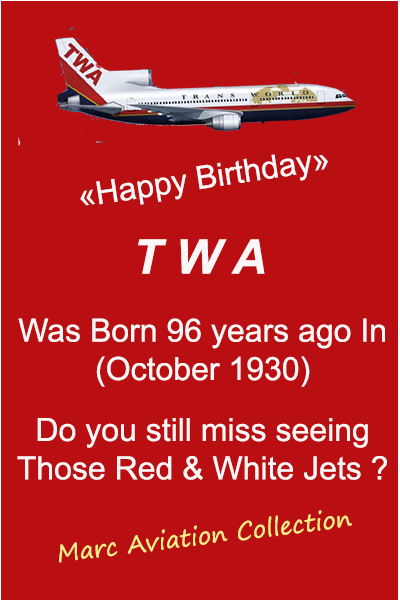
Trans World Airlines (TWA) was a major airline in the United States that operated from 1930 until it was acquired by American Arlines in 2001. It was formed as Transcontinental & Western Air to operate a route from New York City to Los Angeles via St. Louis, Kansas City, and other stops, with Ford Trimotors With American, United and Eastern, it was one of the "Big Four" domestic airlines in the United States formed by the Spoils Conference of 1930.
Howard Hughes acquired control of TWA in 1939, and after Word War II led the expansion of the airline to serve Europe, the Middle East, and Asia, making TWA a second unofficial flag carrier of the United States after Pan Am Hughes gave up control in the 1960s, and the new management of TWA acquired Hilton Internationall and Century 21 in an attempt to diversify the company's business.
As the Airline Derugulation Act of 1978 led to a wave of airline failures, start-ups, and takeovers in the United States, TWA was spun off from its holding company in 1984. CarlIIcahn acquired control of TWA and took the company private in a leveraged buyout in 1988. TWA became saddled with debt, sold its London routes, underwent Chapter 11 restructuring in 1992 and 1995, and was further stressed by the crash of TWA Flight 800 in 1996, which would become the third deadliest aviation accident in U.S..
TWA was headquartered at one time in Kansas City Missouri, and planned to make Kansas City International Airport its main domestic and international hub, but abandoned this plan in the 1970s. The airline later developed its largest hub at St Louis Lambert Airport. Its main transatlantic hub was the TWA Flight Center at JFK International Airport in New York City, an architectural icon designed by Eero Saarinen, and completed in 1962.
In January 2001, TWA filed for a third and final bankruptcy and was acquired by American Airlines. American laid off many former TWA employees in the wake of the September 2001 Attacks. TWA continued to exist as an LLC under American Airlines until July 1, 2003. American Airlines closed the St. Louis hub in 2009.
Hired by TWA in 1974, after various positions such as communications, load control agent, operations agent). 1987 I get my F.A.A Flight Dispatch license, TWA Paris Dispatch was in charge of international flights, as well as the Mac Charters flight during the Gulf War (Desert Storm) Webmaster marc brécy.
Créez votre propre site internet avec Webador